Park Chung Hee Era by Byung-kook Kim & Ezra F Vogel
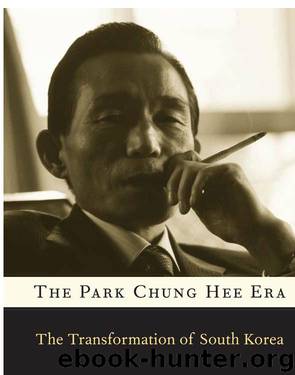
Author:Byung-kook Kim & Ezra F Vogel [Kim, Byung-kook & Vogel, Ezra F]
Language: eng
Format: epub
Tags: Harvard University Press
ISBN: 9780674058200
Published: 0101-01-01T00:00:00+00:00
p a r t
i v
INTERNATIONAL
RELATIONS
c h a p t e r
f o u r t e e n
The Vietnam War:
South Korea’s Search for
National Security
Min Yong Lee
Au.s. senator once calledSouthKorea’smilitarytroopsfightingin South Vietnam “mercenaries.”1 By contrast, many of Park Chung Hee’s domestic critics believed that South Korea dispatched its combat troops because of U.S. political pressure. Either way, Park was portrayed as a man of moral shortcomings, a willing mercenary on a military mission abroad either for money or a reluctant instrument of U.S. imperial ambitions. The reality, however, was much more complex. Presumably Park could have accommodated U.S. demands by going only part way, limiting the dispatch of military troops to noncombat forces. Or he could have sent a smaller force of combat troops. But Park picked one of the best units in South Korea’s army, the Tiger Division, responsible for the defense of Seoul, to be the first combat force to be sent in 1965.2 The White Horse Division that followed in 1966, too, had an impeccable reputation. Moreover, it was not U.S. policymakers but Park who proposed sending the South Korean combat troops in 1961. At the height of the allied military intervention, some 50,000 South Korean soldiers fought side by side with 550,000 U.S. troops in South Vietnam.
The Vietnam War became important to South Korea because Park made it important. Even if the threat of a “domino effect” was real, there was always the politically easy option of a free ride, letting the United States provide regional stability and containment by itself. Moreover, South Korea was neither an ally of South Vietnam nor a member of the Southeast Asia
International Relations 404
Treaty Organization (SEATO). On top of that, the South Korean military situation at home was itself precarious, depriving Park of the luxury of worrying about other countries’ security problems. Given the North Korean military threat, South Korea was not a likely candidate to provide the most significant support out of all other nations for the U.S. military campaign in South Vietnam. Yet it participated in the Vietnam War with the second-largest number of military troops after the United States.
Chapter 14 argues that despite the huge economic benefits, Park’s most compelling reason to intervene militarily in the Vietnam War was political: to prevent the United States from redeploying its troops from South Korea to South Vietnam; to acquire a modern armed forces with combat experience; and to make himself an indispensable strategic ally of the United States in its cold war campaigns, with an eye to discouraging U.S. political forces from joining South Korean opposition politicians and chaeya activists in an anti-Park transnational coalition. Park hoped to make South Korea an anchor in his ally’s Asia policy by helping the United States where it most needed help. The U.S. good will Park secured by coming to the rescue of Lyndon B. Johnson in the Vietnam War and, by extension, by helping to counter some of the U.S. domestic political turmoil over war efforts in South Vietnam (by showing that the United States was not alone in its stance there), was intended to influence U.
Download
This site does not store any files on its server. We only index and link to content provided by other sites. Please contact the content providers to delete copyright contents if any and email us, we'll remove relevant links or contents immediately.
| Arms Control | Diplomacy |
| Security | Trades & Tariffs |
| Treaties | African |
| Asian | Australian & Oceanian |
| Canadian | Caribbean & Latin American |
| European | Middle Eastern |
| Russian & Former Soviet Union |
The Secret History by Donna Tartt(19006)
The Social Justice Warrior Handbook by Lisa De Pasquale(12178)
Thirteen Reasons Why by Jay Asher(8874)
This Is How You Lose Her by Junot Diaz(6859)
Weapons of Math Destruction by Cathy O'Neil(6251)
Zero to One by Peter Thiel(5770)
Beartown by Fredrik Backman(5719)
The Myth of the Strong Leader by Archie Brown(5482)
The Fire Next Time by James Baldwin(5414)
How Democracies Die by Steven Levitsky & Daniel Ziblatt(5200)
Promise Me, Dad by Joe Biden(5132)
Stone's Rules by Roger Stone(5066)
A Higher Loyalty: Truth, Lies, and Leadership by James Comey(4941)
100 Deadly Skills by Clint Emerson(4901)
Rise and Kill First by Ronen Bergman(4764)
Secrecy World by Jake Bernstein(4729)
The David Icke Guide to the Global Conspiracy (and how to end it) by David Icke(4687)
The Farm by Tom Rob Smith(4490)
The Doomsday Machine by Daniel Ellsberg(4475)
